

Artificial intelligence for highways
Your highway already has cameras. Now they detect incidents and count traffic.
Omnivias turns existing CCTV into incident alerts (DAI, Automatic Incident Detection) and traffic data (SAT) for the Traffic Operations Center, with no roadworks and no need to replace your infrastructure. More than 1,000 cameras are in production.
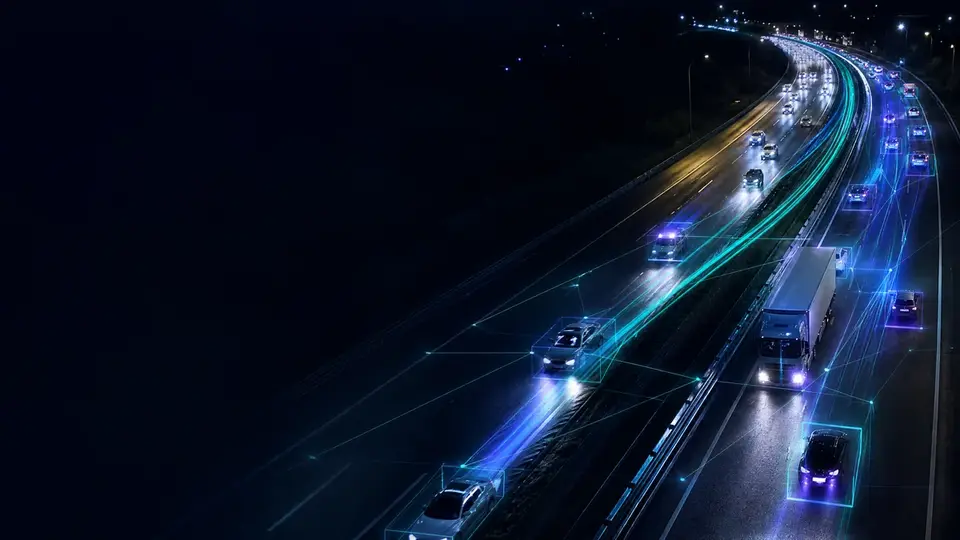
| Vehicles | 1,284 |
|---|---|
| Trucks | 19% |
| V85 speed | 92 km/h |
| Density | 14 veh/km/lane |
- 1,000+ cameras
- in production with SAT and DAI
- Above 95%
- counting accuracy against the field reference
- Below 10%
- unfounded alerts after site calibration
- Zero roadworks
- on the carriageway: it uses the CCTV you already have
DAI and SAT for highways
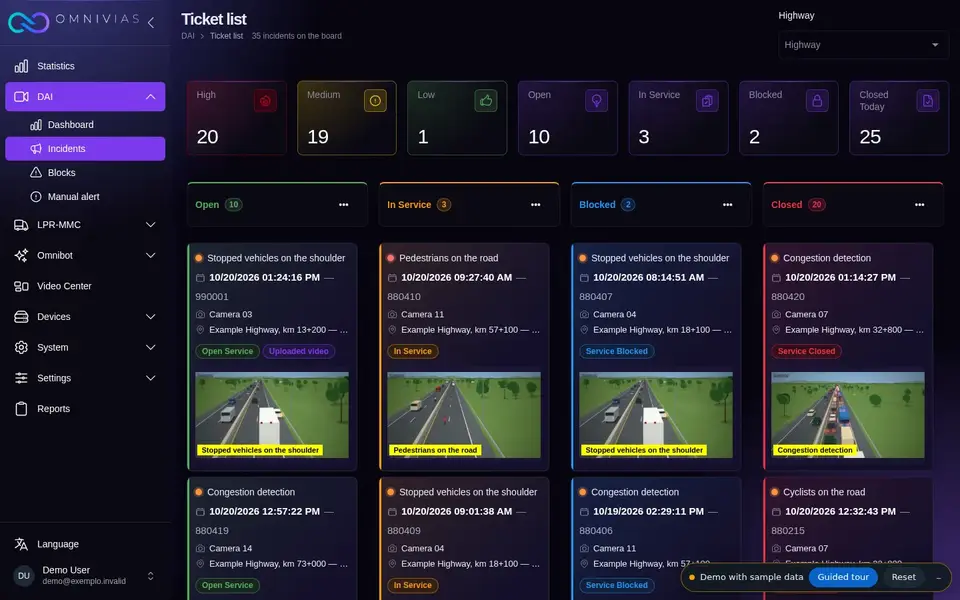
DAI turns video into incident alerts. SAT turns video into traffic metrics. Both share cameras, architecture, users, data and integrations.
DAI
Automatic Incident Detection
- Stopped vehicles and wrong-way driving
- Pedestrians, cyclists and animals on the road
- Fire and smoke in the right-of-way
- Queues, congestion and lane obstruction
SAT
Camera-based Traffic Analysis System
- Volume by lane, direction and road section
- Vehicle classification and axles
- Speed, V85 and density
- HCM parameters and regulatory reports
Omnivias DAI meets the minimum intelligent video analytics functions of the CFTV-IVA specification issued by ARTESP, the São Paulo state transport regulator: stopped vehicle, lane obstruction, pedestrians and animals, fire and smoke, and wrong-way vehicles. What ARTESP requires.
See the platform in action, no sign-up
The demo is the same product that runs in traffic operations centers, with sample data generated in your browser. No client footage, no login.
From video to decision
Computer vision, GPU processing, data, dashboards and integrations that expand situational awareness in the Traffic Operations Center.
Camera
Fixed and PTZ cameras already installed on the highway.
Inference
GPU servers analyze the video close to the cameras.
Event
Every detection becomes a metric (SAT) or a qualified alert (DAI).
Control center
The operator receives it in the Omnivias interface or in the system already in use.
History
Traceable reports and time series for engineering and regulation.
In production, beyond SAT and DAI
The platform brings together the tools operations use every day. Everything below is already running on highways.
Camera wall and map
Live, with the latest events highlighted and their location on the road section.
Text search in video
Find recorded scenes by describing what you are looking for, such as “truck on the shoulder”.
License plate recognition
Plate reading for lookups, lists and passage records.
Zone editor by preset
Lanes, shoulder, counting lines and direction drawn per camera and per PTZ position.
False alarm report
By camera and by event type, to calibrate where a rule gets it wrong.
Camera health
Camera offline, view blocked or out of position, with automatic camera recovery.
Analyze uploaded video
Upload a recorded file and generate alerts and statistics from it.
Autonomous operation
Each local server keeps analyzing and storing events even without the central site.
Continuous model improvement
Footage from the highway itself strengthens the models throughout operation.
Integration without lock-in
Omnivias can be the main interface of the Traffic Operations Center or an intelligence layer connected to what is already installed. Adopting DAI does not require replacing the control center system.
- Digifort
- Kria
- REST APIs
- Webhooks
- On-demand connectors
Start with a pilot on your own cameras
First we assess the cameras the highway already has; then a proof of concept using footage from the road section itself shows the measured result. Depending on the size of the project, the assessment and the proof of concept can be free of charge, and the proof of concept starts running within 10 days of signing the agreement.
Assessment
Resolution, position, coverage, lighting and network of the existing cameras, against what the operation wants to measure and detect.
Proof of concept
SAT and DAI running on footage from the road section itself, measured against the agreed success criteria.
Production
On-premises, cloud or hybrid architecture, control center integration, rules, alerts and reports.
Continuous calibration
Rules and models tuned camera by camera using the real alert history.
Omnicog on VEM.AI, the NVIDIA podcast
Omnicog, the company behind Omnivias, talked about computer vision applied to real operations on NVIDIA’s podcast for Latin America. Omnicog is a member of the NVIDIA Inception program.
Frequently asked questions
Straight answers about DAI, SAT, cameras, the pilot and integration.
What is Omnivias?
Omnivias is the Omnicog Tecnologia business unit specializing in artificial intelligence and computer vision for highways. It turns video from cameras already installed on the road into traffic data (SAT) and incident alerts (DAI, Automatic Incident Detection), delivered through dashboards, reports and integrations with the Traffic Operations Center.
Which incidents does DAI detect?
Vehicles stopped in a lane, on the shoulder or in the right-of-way, wrong-way driving, pedestrians and cyclists, animals on the road, fire and smoke, congestion and queues at toll plazas, cone-marked work zones, prohibited passing by vehicle type, and objects, debris and lane obstruction.
Does DAI meet the ARTESP CFTV-IVA specification?
Yes. Omnivias DAI meets the minimum intelligent video analytics functions of the ARTESP CFTV-IVA technical specification: stopped vehicle, lane obstruction, pedestrians and animals, fire and smoke, and wrong-way vehicles.
Can we use our existing cameras?
Yes. Omnivias uses fixed and PTZ cameras whenever resolution, positioning, coverage, lighting and stability meet the objective. The pilot assessment tells you, camera by camera, which ones qualify.
What is the difference between SAT and DAI?
SAT produces traffic metrics such as volume, classification, speed and density. DAI identifies operational events, such as a stopped vehicle or wrong-way driving, and generates alerts. Both can use the same camera.
How does the pilot work?
Camera assessment, a proof of concept using footage from the road section itself, then production and continuous calibration. Depending on the size of the project, the assessment and the proof of concept can be free of charge, and the proof of concept starts running within 10 days of signing the agreement.
How much does it cost?
Pricing is on request, because it depends on the number of cameras, the events the operation wants to detect and measure, and the architecture (on premises, cloud or hybrid). The camera assessment is the first step to size the proposal.
Can I see the platform in action before we talk?
Yes. The interactive demo at omnivias.com.br/demo is the real product with sample data generated in your browser, with no sign-up and no client footage.
Can it integrate with our existing Traffic Operations Center?
Yes. Omnivias integrates with Digifort and Kria and offers REST APIs, webhooks and on-demand connectors. It can be the main interface or an intelligence layer connected to the tools the control center already uses.
How many cameras are in production?
More than 1,000 cameras in production with SAT and DAI. At Rota de Santa Maria, more than 400 cameras run SAT and DAI, over two years of operation.
Tell us about your operation
Share your current infrastructure, the challenges on your road section and the goal of the assessment. The Omnivias team joins the conversation with context and proposes a pilot using footage from your own highway.
- Phone and WhatsApp
- +55 11 3636-8989
- Address
- São Paulo, SP, Brasil